F1 Duration of Status 2027: 4-Year Rule Vacated, 60-Day Grace Period Remains
F1 duration of status remains in place after the court vacated the 4-year rule. Check the 60-day grace period, DSO extensions and critical updates for 2027.
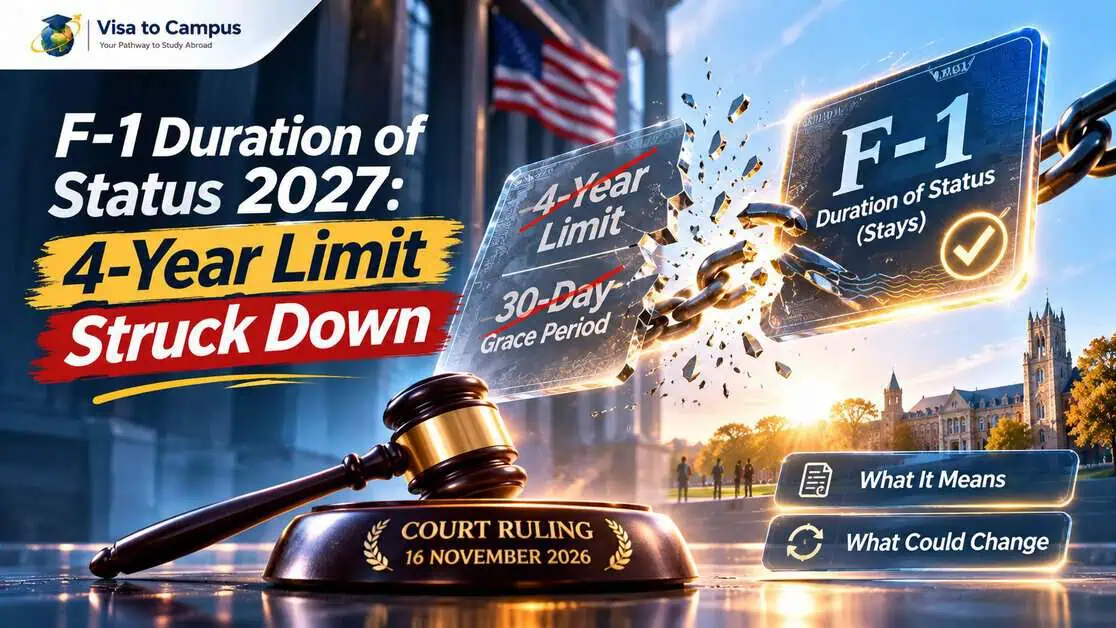
F1 Duration of Status 2027: 4-Year Limit Struck Down, 60-Day Grace Period Stays
Last updated: 21 November 2026
F1 duration of status is staying: the 4-year limit and 30-day grace period you may have read about are not in effect, because a federal court struck down that rule on 16 November 2026. The rule never took effect, so students are still admitted for duration of status (D/S), and anyone finishing a program still has 60 days afterwards. Here is what the struck-down rule would have changed, what could still revive it, and what to check before your next trip or graduation.
Quick answer:
- Duration of status:still in force for F-1 students
- 4-year limit:never took effect; the rule was vacated (cancelled by the court) on 16 November 2026
- Grace period:still 60 days after program completion
- Extensions:still through your Designated School Official (DSO) before the Form I-20 end date
- What could change:an appeal or a new rule; nothing is in effect today
F1 Duration of Status in 2027: Where Things Stand
For anyone planning study in 2027, F-1 duration of status is the rule that applies, because the court cancelled the new rule outright rather than sending it back for repairs.
What the Court Decided on 16 November 2026
In Presidents’ Alliance on Higher Education and Immigration v. DHS, university associations and unions, including NAFSA, asked Judge F. Dennis Saylor IV of the US District Court for the District of Massachusetts for summary judgment (a final decision without a trial). The duration of status court ruling granted it and vacated the rule in its entirety, noting that it had never taken effect.
The court gave two grounds. First, the rule was arbitrary and capricious under the Administrative Procedure Act: DHS had not properly weighed costs, public comments, or less burdensome options such as improving SEVIS, the existing student tracking system. Second, its limits on academic study went beyond DHS’s legal authority, because they had no reasonable link to the purpose of the F-1 category.
How the Rule Was Blocked, Then Vacated
DHS proposed ending D/S in August 2025 and published the DHS final rule in July 2026, set to start on 15 September. The groups sued in August, as the duration of status lawsuit tracker records, and a preliminary injunction (a temporary block) stopped the rule the day before it began. The November ruling made that block permanent. This timeline gives the exact dates.
| Date | What happened |
| 28 Aug 2025 | Rule proposed |
| 17 Jul 2026 | Final rule published |
| 18 Aug 2026 | Lawsuit filed |
| 14 Sep 2026 | Court blocks rule |
| 16 Nov 2026 | Rule vacated |
Is the F1 4-Year Limit in Effect? Why Old Posts Say Yes
No. Many pages that appear when you search F1 duration of status were written between July and September 2026, while the rule still had a start date. Some have not been updated, so check the date on anything you read before you act on it.
What the Vacated Duration of Status Rule Would Have Changed
The vacated rule would have replaced open-ended D/S with fixed end dates, a shorter grace period and new limits on changing programs. This comparison separates what applies today from what never took effect.
| Rule area | Current rule | Vacated rule |
| Admission period | Duration of status | Fixed, 4-year maximum |
| Grace period | 60 days | 30 days |
| Extension | Through DSO | USCIS application |
| Program changes | Allowed with DSO | Restricted |
Fixed Admit-Until Dates on the I-94
Under the DHS final rule, each F-1 student would have received an admit-until date on the Form I-94 arrival record, set at the length of the program but no more than four years. To stay longer, a student would have needed to apply for an extension or leave and re-enter the US.
This was a limit per admission, not a lifetime cap. Because re-entry could start a new admission period, it would not have capped total years in F-1 status; it would have forced more applications or trips.
PhD Students Keep F-1 Duration of Status
Doctoral students and anyone in a program longer than four years would have been hit hardest. Nothing changes for them now: their D/S admission covers the whole program for as long as they maintain status.
The F1 30-Day Grace Period and USCIS Extensions
The rule would have cut the time to depart after completing a program or post-completion OPT from 60 days to 30 days. That F-1 30-day grace period never applied to anyone.
Extensions would have moved from your DSO to US Citizenship and Immigration Services (USCIS). Students would have applied for an extension of stay, with biometrics collected as part of the application, and then waited for a decision.
Limits on Transfers and Program Changes
The rule would have restricted academic mobility in three ways:
- students would generally have needed to finish their first academic year before transferring or changing their educational objective, unless the Student and Exchange Visitor Program (SEVP) granted an exception
- graduate students would have been barred from changing their educational objective at any point, and from transferring without an SEVP exception
- F-1 students would have been barred from moving to a program at the same or a lower educational level
These are the limits the court found beyond DHS’s authority.
F1 Rules Still in Force
The F-1 rules that applied before July 2026 still apply today.
What Does F-1 Duration of Status Mean?
It means you are admitted for as long as you pursue a full course of study and maintain status, not until a fixed date. The maintaining F-1 status guide from Study in the States explains that the “Admit Until” date on an F-1 student’s I-94 should read D/S. D/S is not unlimited, though: it ends when you complete your program or stop maintaining status.
The 60-Day F1 Grace Period After Graduation
After you finish your program, or any post-completion OPT, the 60-day grace period still applies. The official F-1 grace period options let you enrol in a new program that starts within five months, request a change of status from USCIS, or travel within the US while preparing to leave.
If you plan post-completion OPT, USCIS must receive your application within this window. Our comparison of CPT vs OPT for F1 students explains how to time it.
Program Extensions Through Your DSO and Form I-20
If you need more time, ask your DSO early. Under the F-1 program extension rules, a DSO extends your program in SEVIS before your program end date, for an academic or medical reason.
Maintaining status also means enrolling full time in each required term, as the maintaining F-1 status guide sets out, plus keeping your address current with your DSO and your passport valid.
SEVP’s August 2026 guidance restricting CPT is a separate policy that this ruling did not address; a court stay on CPT restrictions paused it on 17 November 2026, so ask your DSO how it applies at your school. We plan to cover that case in a separate post.
Could the F1 4-Year Limit Come Back?
It could, but only through further court action or a new rule, and neither had happened as of 21 November 2026.
DHS Appeal and Stay Possibilities
DHS may appeal the duration of status court ruling to the US Court of Appeals for the First Circuit. As the plaintiffs’ duration of status litigation page notes, filing an appeal would not by itself suspend the ruling. However, things could change if a court stays or reverses the ruling, because a stay (a pause on the ruling) could let DHS act while an appeal runs.
DHS’s earlier appeal concerns the September injunction. According to the duration of status lawsuit tracker, the First Circuit put it on hold on 13 November 2026, and it may become moot now that a final judgment exists. Both pages are the quickest places to check for new filings.
A New DHS Rulemaking
DHS could also start again. A new rule would normally need a published proposal, a public comment period and a final rule with a new effective date; this one took almost a year from proposal to publication. Any new duration of status rule would also have to answer the court’s reasoning.
What F1 Students Should Do Now
Carry on under F-1 duration of status as usual, and use this checklist to find your next step.
|
Your situation |
What to do |
|
Starting in 2027 |
Check I-94 record |
|
I-94 shows date |
Contact your DSO |
|
Program ending soon |
Plan extension early |
|
Planning OPT |
Track filing window |
|
Travelling abroad |
Ask international office |
New Students Starting in 2027: Check Your I-94
If you start your program in 2027, prepare and enter the US as normal with your visa, passport and I-20; no new admission rule applies to you. Our USA post-visa approval checklist covers the steps before you fly.
A few days after arrival, use the official I-94 lookup. The “Admit Until” date should read D/S; if it shows a fixed date, contact your DSO quickly so the record can be corrected.
Keep university email notifications on, because your international office usually sends updates first.
Current Students and Upcoming Graduates
If your program end date is approaching and you need more time, talk to your DSO now about an I-20 extension, well before the deadline. Then plan your next step around graduation or travel.
Planning OPT Within the Grace Period
If you graduate soon and plan OPT, the post-completion OPT filing window opens 90 days before your program end date and closes 60 days after it. You must also file within 30 days of your DSO’s recommendation, so filing early gives you a margin.
Travelling Abroad This Winter
If you are travelling abroad this winter, check with your international office before you book, and confirm that your visa, passport and I-20 travel signature are in order. A normal winter break does not affect D/S; only a long absence does, as the five-month rule in the FAQs explains.
F1 Rule Change 2027: Frequently Asked Questions
What are the new F1 visa rules for 2027?
No new rule limits how long F-1 students can stay in the US. The duration of status court ruling cancelled the 4-year limit, and the August CPT restrictions are paused under the court stay on CPT restrictions. Separately, DHS published a proposed OPT fee rule on 8 October 2026; it would charge schools, not students, and is not in effect.
How long can an F1 student stay in the US?
Under F-1 duration of status, you stay as long as you pursue a full course of study and maintain status, plus any authorised practical training such as OPT. After you finish, you have 60 days to leave, change status or enrol in a new program. There is no fixed number of years; the vacated 4-year limit would have changed that.
What is the 5-month rule for F1 students?
If you leave the US for more than five months and cannot stay enrolled at your school, you lose F-1 status. Returning then requires a new Form I-20, as the USCIS five-month absence guidance explains. Approved study abroad counts as a temporary absence. The court ruling does not change this rule.
How can I check my F1 status?
Your I-94 shows your class of admission (F-1) and D/S; download it from the official I-94 lookup after each entry. Your SEVIS record should be Active while you study, which your DSO can confirm. Your Form I-20 shows your program end date, the date that matters for extensions and the grace period.
Do F1 students need to file Form I-539 now?
No. The USCIS extension process in the vacated rule never started, so F-1 students do not apply to USCIS to keep studying. Your DSO extends your program by updating the I-20 in SEVIS. Form I-539 remains a USCIS form for other purposes, such as some changes of status, so ask your DSO before filing anything.
Does the ruling affect J-1 students and F-2 dependents?
Yes, in the same way. The vacated rule covered F-1 students and their F-2 dependents, as well as J-1 exchange visitors and their J-2 dependents, so all of them keep duration of status. F-2 status follows the F-1 student’s status. J-1 participants should confirm program extensions with their J-1 program sponsor rather than a DSO.
Does the ruling affect H-1B or other visa types?
No. The case concerned only F, J and I admissions, so H-1B, L-1, O-1 and other categories are unaffected by it. It also does not change the H-1B lottery or cap-gap rules. If you plan to move from student to work status, our guide to the F1 to H1B visa transition explains each step and its timing.
Should I delay my travel because of the appeal risk?
Not automatically. The ruling is in force today, and an appeal by itself would not revive the rule. However, a court could still grant a stay. If you have trips planned, ask your international office about current guidance, documents and timing before booking, especially for travel close to the start of a term.
What is the difference between a stay, an injunction and a vacatur?
A preliminary injunction temporarily blocks a rule while a case continues; that happened here on 14 September 2026. A vacatur cancels the rule completely, as the court did on 16 November 2026. A stay pauses a court ruling, usually during an appeal. A stay or reversal could revive this rule; a new rulemaking would create a new one.
Does the ruling affect the F1 visa interview?
No. The visa in your passport, issued by the State Department after an interview, lets you ask for entry at a US port. The I-94 admission record, which the vacated rule targeted, is created by border officers when you arrive. The ruling concerns only that admission record, not the visa process.
Disclaimer
This post explains a developing legal situation and is not legal advice. Rules can change after an appeal or new rulemaking. Confirm with your school’s international office (DSO) before making decisions.